AIRVOLT X1
Half Size Inflatable Portable Motorcycle Helmet Concept
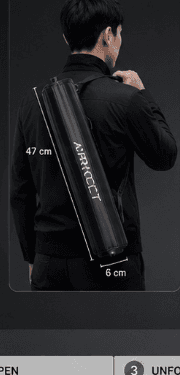
AIRVOLT X1 is an innovative proposed motorcycle helmet concept designed to be carried as easily as an umbrella (47 cm × 6.5 cm cylinder). When unfolded and inflated in 8–10 seconds, it forms a rigid, multi-layered protective cranial shield.
Safety Notice: AIRVOLT X1 is an unvalidated conceptual study. It has not undergone physical drop testing or regulatory homologation and is NOT certified for motorcycle riding.
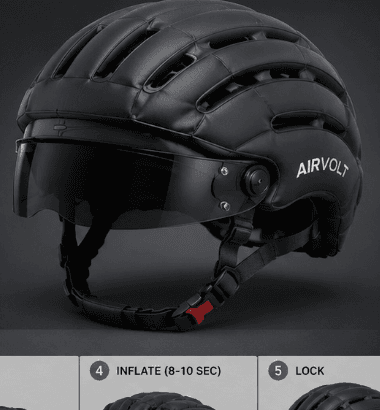
Engineering Specification Documents
Original design blueprints, 3D CAD sheets, and portability layout developed by Faheem Pappat.
“Carry Like an Umbrella. Wear Like a Helmet.”
How AIRVOLT X1 transforms from a slim 47 cm cylinder into a full cranial protective helmet in seconds.
Solving the Daily Motorcycle Helmet Portability Barrier
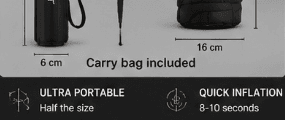
Conventional helmets demand 12 to 16 liters of rigid space, causing millions of urban riders to skip protection due to storage inconvenience. AIRVOLT X1 eliminates this friction by rolling down to a compact 16 cm core that slides into a weatherproof 47 cm cylindrical carrying case.
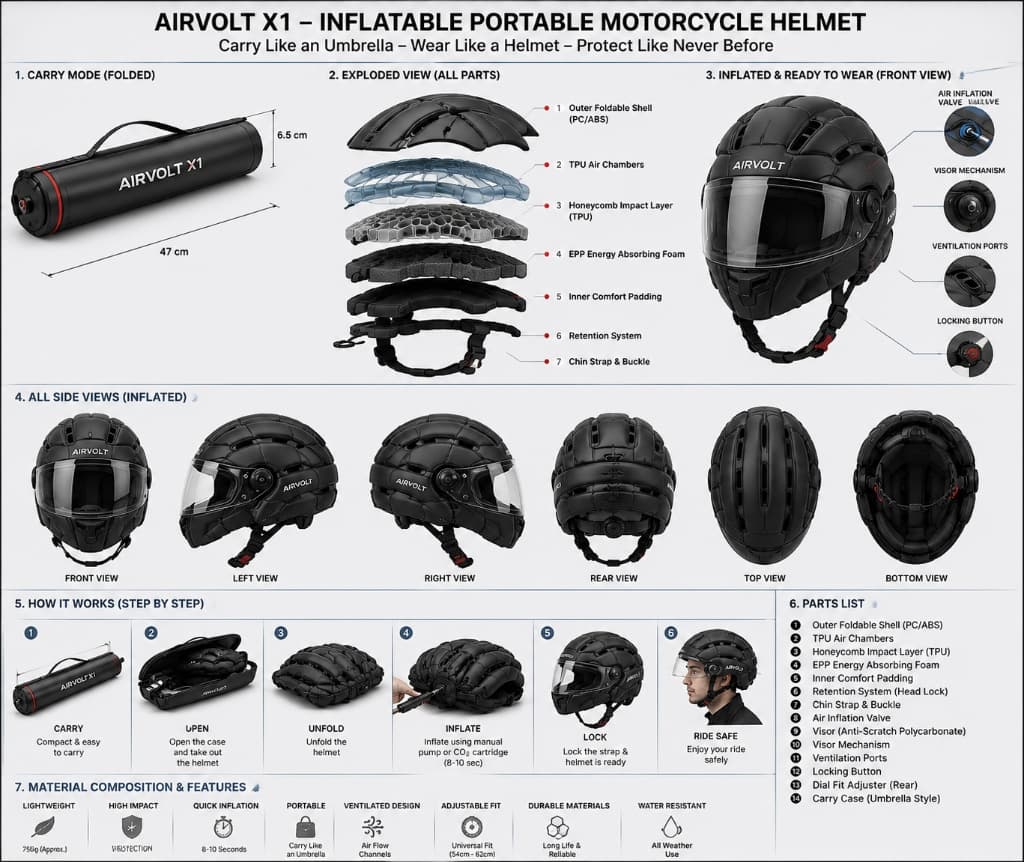
6-View Orthographic Projections
First-angle projection covering Front, Left, Right, Rear, Top, and Bottom views in deployed state.

Exploded Structural Assembly
7-layer composite stack combining articulated outer shielding with dual-stage pneumatic damping.
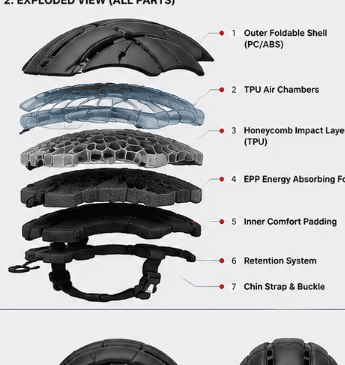
Outer Foldable Shell (PC/ABS)
High-impact articulated polycarbonate/ABS copolymer skeleton that shields against direct abrasion and sharp puncture hazards.
TPU Air Chambers
High-frequency welded multi-cell ether TPU bladder that distributes and decelerates impact forces evenly.
Honeycomb Impact Layer (TPU)
Cellular elastomeric honeycomb web providing structural rebound and progressive deceleration.
EPP Energy Absorbing Foam
Multi-density expanded polypropylene foam blocks engineered for repeated multi-impact resilience.
Inner Comfort Padding
Sweat-wicking, antimicrobial removable liner with integrated 3D breathable airflow mesh.
Retention System (Head Lock)
Ergonomic occipital cradle with rotary dial tensioner for custom circumference stabilization.
Chin Strap & Buckle
High-tensile woven nylon webbing anchored to rigid skeleton with steel micrometric quick-release latch.
How It Works — 6-Step Sequence
From carrying mode to riding ready in under 15 seconds.
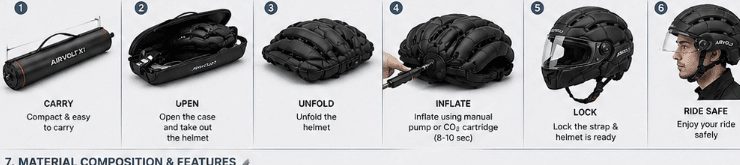
Compact & easy to carry in umbrella-style cylinder sleeve (47 cm × 6.5 cm).
Unzip or unlatch the rigid travel case and take out the folded helmet assembly.
Unfold articulated shell vertebrae along titanium pivot hinge ribs.
Inflate internal TPU bladder in 8–10 seconds using manual pump, mini electric pump, or CO2 cartridge.
Lock the chin strap harness and adjust the dial fit adjuster for secure cranial engagement.
Enjoy your ride safely with smoked optical visor, multi-layer impact absorption, and air ventilation channels.
Related Inflatable Protection Systems
Sister concepts engineered by Faheem Pappat applying inflatable pneumatic impact mitigation across different mobility categories.
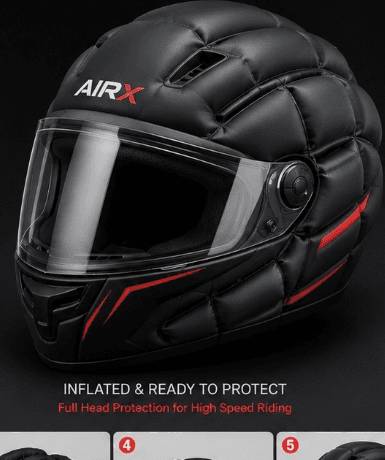
AIRX Inflatable Full-Face Helmet
Engineered for high-speed highway riding with an articulated ABS+PC outer shell, integrated chin bar, and dual-zone air ventilation channels.
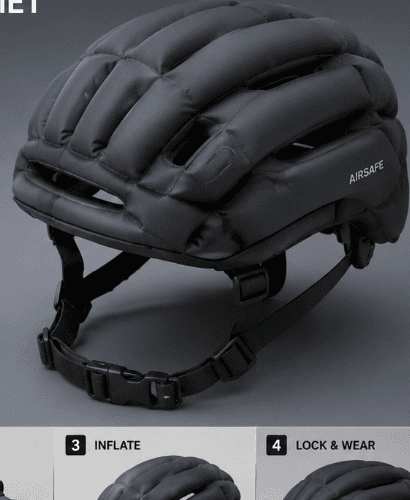
AIRSAFE Inflatable Bike Helmet
Engineered for urban commuters and micro-mobility riders. Folds into a compact zippered oval pod with 360° air-cushion cranial protection.
Interactive 360° Kinematic Model
Drag to rotate and inspect the interlocking shell segments and titanium pivot pins in real-time.
Spatial 360° Concept Inspection
Click & drag to rotate azimuth // Inspect modular interlocking geometry
Bi-Stable Titanium Hinge Hub
Ti-6Al-4V dual-shear pivot allowing the frontal arch to collapse flush against the crown.
Impact-Force Management & Stopping Distance
Biomechanics and peak cranial deceleration (G) attenuation physics comparing standard EPS vs pneumatic hybrid damping.
Deceleration Profile: Impulse-Momentum Management
Hypothetical comparison of cranial acceleration (G) vs. time duration (ms)
By increasing cranial stopping distance d from 18 mm to 26 mm through combined pneumatic deflection and liner crush, the average deceleration force F is mathematically reduced by up to ~30%.
In real motorcycle crashes, 70%+ of impacts occur at oblique angles, causing destructive rotational acceleration that tears neural axons. The segmented shell allows 8–12 mm of multi-directional shearing to deflect rotational forces away from the brainstem.
Preliminary Prototype Roadmap
Phased verification targets from kinematic synthesis to statutory homologation.
Conceptual Formulation & Kinematic Synthesis
Establish folding kinematics, volumetric limits, and 3D CAD parametric skeleton geometry.
Pneumatic Bladder & Latch Bench Prototyping
Fabricate functional TPU welded bladders and test rapid deployment with 16g CO2 micro-canister.
Structural Drop-Tower Rig Testing
Conduct simulated drop impacts on instrumented headforms according to ECE 22.06 flat and curbstone anvils.
Ergonomics, Wind Tunnel & Weather Trials
Evaluate acoustic noise, wind aerodynamic buffet at 100 km/h, and extreme hot/cold endurance.
Formal Homologation & Independent Certification
Submit production-grade units to accredited testing laboratories for official safety certifications.
AIRVOLT X1 Technical FAQs
Direct answers to common engineering questions regarding the concept.
What is AIRVOLT X1?
The project was conceived by Faheem Pappat at WesbondX in Malappuram, Kerala, India. It focuses on tackling the commuter inconvenience problem that prevents millions of riders from carrying certified helmets during urban commutes.
How could an inflatable motorcycle helmet work?
Crucially, the air pressure works synergistically with the rigid skeleton. The gas cushion provides pneumatic damping, while the mechanical over-center latches ensure the helmet maintains its protective vault even if pressure fluctuates.
Which materials might be suitable?
These material selections are preliminary engineering recommendations based on established automotive and aerospace standards. Physical stress testing, thermal cycling, and finite element modeling are required to finalize formulations.
How could impact force be managed?
According to the impulse-momentum theorem, extending deceleration distance even by several millimeters can lower the peak G-forces transmitted to the brain below critical concussion and traumatic brain injury (TBI) levels.
What are the main engineering challenges?
Each of these challenges is being methodically documented and addressed through mechanical fail-safes (such as labyrinthine overlapping joints and mechanical over-center latches that remain rigid even during pressure loss).
Is AIRVOLT X1 a tested product?
WesbondX strictly adheres to honest technical documentation. We do not claim any simulated or fabricated certifications. The project is an open design exploration seeking academic and industrial research partnerships.
Can the concept currently be used on public roads?
Motorcyclists must only wear helmets certified by recognized regional bodies (such as UN ECE 22.06, DOT FMVSS 218, or BIS IS 4151).